Marbler's Guide - Black and White
przez Adam Piskorek
The Physics of Marbling Lives in Water
Physics governs both the everyday world and the marbling tray. Knowledge elevates technique beyond trial-and-error into reproducible mastery.
Shade Balls on the Tray
Reservoirs use black plastic shade balls to reduce water evaporation. Each ball floats, shedding no ions, no reactivity—pure physics.
A paint drop on marbling solution behaves identically. Inorganic pigments (metal salts, oxides, carbon) behave like shade balls: they float on the solution surface, spreading predictably, transferring cleanly to paper.
Example: Lamp Black (carbon, PBk6). Carbon is elementally inert—no charge, no chemical reactivity. It floats. It spreads. It stays where you put it.
Organic Pigments vs. Inorganic Pigments
Inorganic Pigments
- Elements: metal oxides, salts, pure carbon
- Behavior: float on solution surface, predictable spreading
- Examples: earth pigments (iron oxides), titanium white, lamp black
- Recommendation for beginners: Base your palette on inorganic pigments
Organic Pigments
- Structure: complex carbon molecules (phthalocyanines, anthraquinones, etc.)
- Behavior: may sink into solution, resist spreading, yield weaker colors, foul the solution faster
- Examples: some reds, some blues, many modern art paints
- Recommendation: Avoid until you've mastered inorganic pigments
White Pigments: Passive Preservatives
Zinc White (PW5) and Titanium White (PW6) behave unusually in marbling.
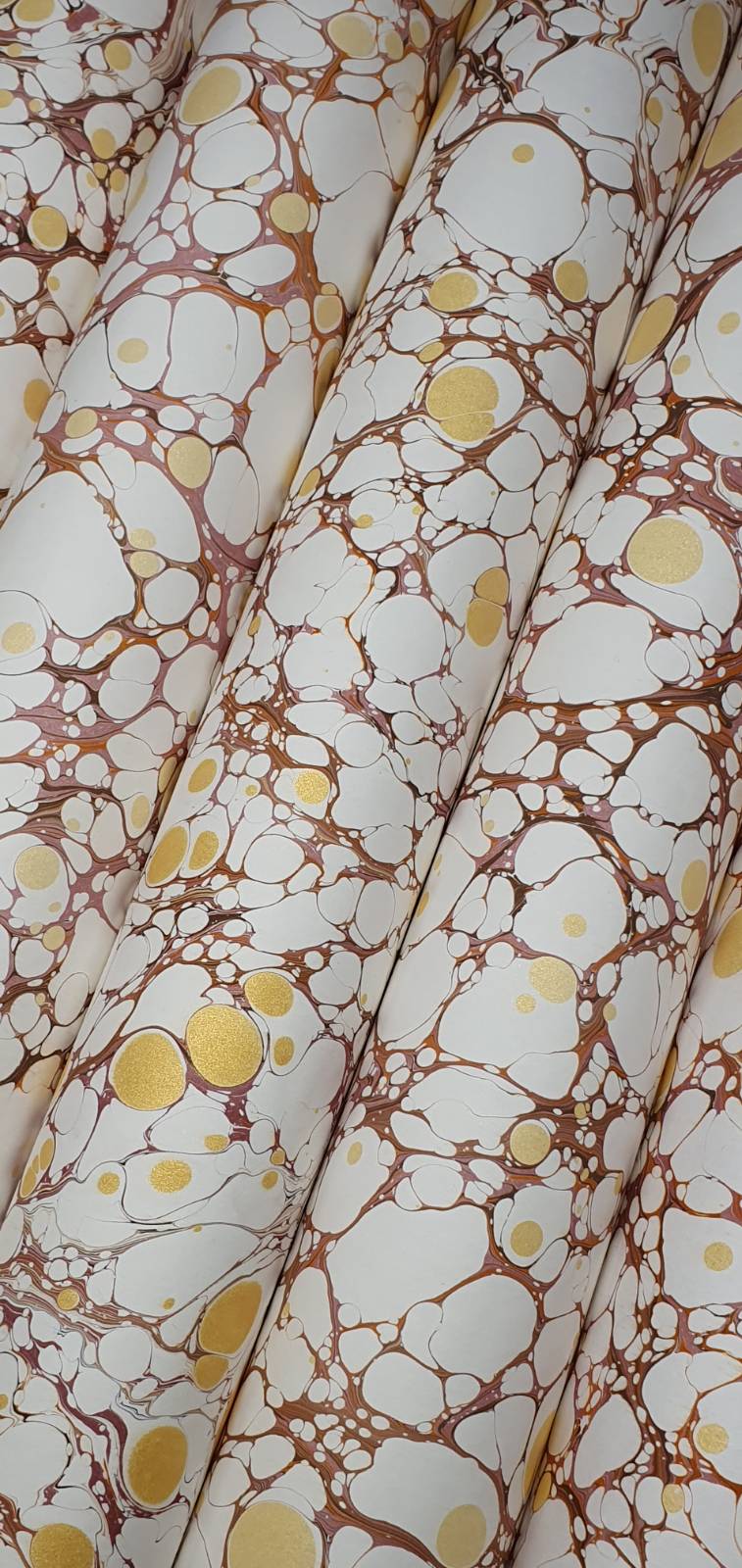
In Italian patterns, white often appears as bare paper—not painted white, but empty space. Yet white pigments are inorganic, float well, and spread predictably.
Key insight: These whites have antifungal and antibacterial properties. They act as natural preservatives for your marbling solution.
Why it matters:
- Marbling solution degrades over time (microbes, temperature swings, dust)
- A solution "dies" when it becomes cloudy, smells, develops visible mold
- Zinc white and titanium white extend solution life by weeks
- Use them not just for patterns, but as a preservation strategy
Practical Guidance
For your tray:
- Prioritize inorganic pigments (earth tones, blacks, whites)
- Add zinc white or titanium white to your solution even if you don't use it for patterns—it extends the solution's lifespan
- Avoid organic pigments until you've mastered the craft
- Temperature control (23–26°C) + white pigments = solution lasting 4–6 weeks instead of 1–2 weeks
The art of marbling is, ultimately, the art of understanding your solution. Master this, and patterns follow naturally.